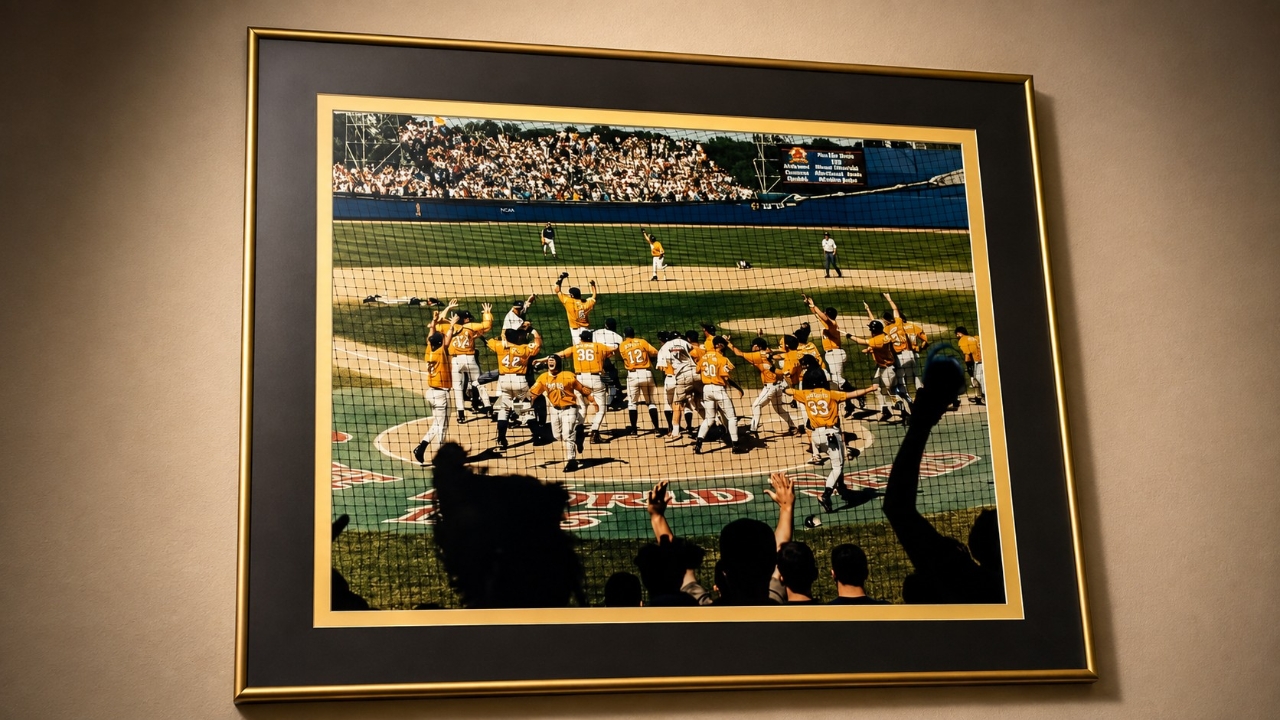
The picture still hangs over my desk.
Warren Morris almost halfway between second and third, arm raised over his head, trotting towards his jubilant teammates behind home plate.
It's fitting that the signature moment for the greatest college baseball coach of all time is also the greatest moment in the history of the College World Series.
Skip Bertman was not satisfied to merely be excellent. He wanted to be the absolute best.
He was.
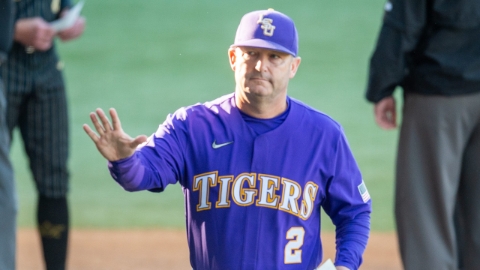
Bertman passed away peacefully early Friday morning surrounded by his family, leaving a legacy on a school, a community, and an entire sport that would be impossible to overstate.
Sports love hyperbole. Playing chess while his opponents played checkers. Always a step ahead of the competition. Seeing the game in a way nobody else did.
The GOAT.
In the case of Bertman, none of them were exaggerations.
By the time I covered my first LSU baseball practice, Bertman had already won two National Championships. As we waited for him, I looked into the dugout, filled with bats, balls, helmets, and other gear, and saw something next to him that caught my attention.
A leather briefcase.
For a moment it seemed out of place, something more relatable to a stockbroker than a baseball coach, but to this coach, it was more than teaching the game. Baseball was his business.
His winning attracted the fans. His financial acumen made him a model for athletic directors.
Skip Bertman had impeccable timing. The 1990's belonged to LSU baseball, and Louisiana sports fans needed them badly.
The Tiger football and basketball teams struggled throughout most of the decade. The Saints were still yet to win a playoff game.
LSU baseball was a source of pride. Yeah, the other teams are struggling, but just wait until next May and June. The big purple and gold machine was going to steamroll right over you.
Five in ten. Try to top that.
Skepticism was for the uninformed, as Marvin Dugas, the "Big Ragoo" himself, told me in the lobby of the Omaha Embassy Suites in early June of 1996.
"We got one five in the dugout," he told me, with the confidence of a poker player who knows he has the best hand. Nothing else needed to be said.
The success he had on the field was due to a lifetime of sweating the details. He once said that if he saw a hole in the netting behind home plate at a visiting stadium, he knew his team would win.
"That guy isn't taking care of the details," he said. "I could always beat that guy."
The coffee had to be hot. The soft drinks had to be cold. The lines for the restroom had to be short. Why? Because that would bring families to the games. It created a home field advantage that remains unmatched in college baseball.
And it was sustainable.
Because if the mother and father brought the son and the daughter to the games, and the experience was enjoyable, the kids were more likely to return to the games one day with children of their own.
"The first few seasons of the Bertman era, you could bring a family of four to every game at Alex Box Stadium for fifty dollars a year," said Bill Franques, for 38 seasons the LSU baseball Sports Information Director.
A deal at twice the price.
Personally, I built a stronger relationship with Bertman after his career in the dugout ended.
I often talked to him in the press box at Tiger Stadium. One particular night, when LSU was routing an outmanned opponent, I commented that I was surprised he had come out for the mismatch.
"I like to talk to people," he replied.
It took me awhile to realize that his vast knowledge of seemingly everything was that he listened to people as much as he talked, and he had an uncanny ability to save the important information and discard the rest.
After talking to so many of his former players and staff members, I've come up with my own theory of why he was such a brilliant strategist.
Bertman had a photographic memory. I realized this one special night (for me), when I found myself broadcasting an LSU midweek game by myself, as my regular partner had a late, unexpected absence.
LSU Sports Properties officials went down the suite level looking for a former player to sit in for a few innings with me. They came back with Skip.
Prior to this, the last time I was nervous on the radio, I was 15 years old doing news reports for Magic 105. Now, here I was, side by side with the legend, expected to talk baseball on an intelligent level with someone who knew the game roughly a billion times better than me.
Of course, it turned out to be the easiest three innings of my career. "Skip, what do you think about (fill in the blank)," was a terrific way to ask a question.
His legendary clairvoyance got home halfway through, when he predicted a strikeout four seconds before it happened.
"How did you know that?" I asked.
He proceeded to describe the pitch sequence to that batter from his prior at bat, when Bertman was sitting down the first base line with no idea he would be asked to be on the broadcast.
A lot of baseball coaches can tell you what every player did in their previous at bat. Really good baseball coaches can remember some specific details from most of the prior at bats.
Skip Bertman could remember every pitch sequence and every defensive alignment from every previous inning.
And all of those from the game the day before. And all of those from the game the day before that.
More importantly, he knew how to use that knowledge to his advantage.
The last time I talked to him was in May, when he guested on my podcast. It was around the celebration of the 30th anniversary of the Warren Morris home run.
I asked him about a play in the game before the final, where Justin Bowles hit a bases loaded single off the wall against Florida that scored only one run.
LSU won the game 2-1. I was at that game, and I am 34 years younger than Bertman. I didn't remember the play, or why the Tigers only got a single run on the hit.
"Yeah, I remember," said Bertman. "The ball was hit so hard off the wall that it came right back to the outfielder. That's why we had to hold the second runner."
The man was a walking, talking, AI response, that also told funny jokes. If there was a WAR for college baseball coaches, Skip would lead the planet.
Probably my favorite show ever involved Skip. One summer, flying solo with Jimmy Ott on vacation, I invited Bertman to be with me for part of a mid-July broadcast.
Much to my delight, he said he would be happy to sit in for the entire show. For two hours, he kept the audience (and me) enthralled with the stories of his career.
From how he raised the money to put chairbacks in the grandstand, to the seedy motel in Memphis where he interviewed Bobby Petrino, to his decision not to bunt Mike Fontenot with the National Championship run on first base in 2000, Bertman was like a book you couldn't put down.
So, I didn't.
When the end of the show approached, I told the producer I was going to keep going. If Bertman was going to keep talking, I was going to keep listening.
This is a gigantic no-no in our business. There are commercial logs to be kept, computer schedules to follow, and employee directives that cannot be dismissed.
I didn't care.
Twenty minutes past time (an eternity in radio), the producer got a call from our President Gordy Rush. "You have to tell him to stop now. As it is we have to reschedule the whole rest of the day!"
Never before or since have I so blatantly violated company policy. Bertman was that good.
Later, Gordy told me he would have probably done the same thing!
So when he approached me years later and asked if I was interested in Skip being a regular guest on our show, I thought he was putting me on.
Would I like to have him for an hour a week? Umm...would the local priests like to interview the Pope every Wednesday?
Jimmy and I were blessed to have Skip for an hour a week for a little over a year. As good as he was on the air, I soon learned not to schedule any appointments after those shows.
Skip might stick around after lunch to talk. And he often did.
I learned more baseball from him than anybody. I discovered more about human nature from him than I could learn from any PhD, because he was the master. I marveled at his ability to tell a story, something I would like to think I am fairly decent at myself, but of course nowhere near as good as Skip.
Pressed for a word to describe his influence, I can only use immeasurable. He is the most important person in the history of athletics at Louisiana State University.
Skip may be gone, but his presence will forever grace the halls, walk the grass, and man the dugout as long as there is an LSU.