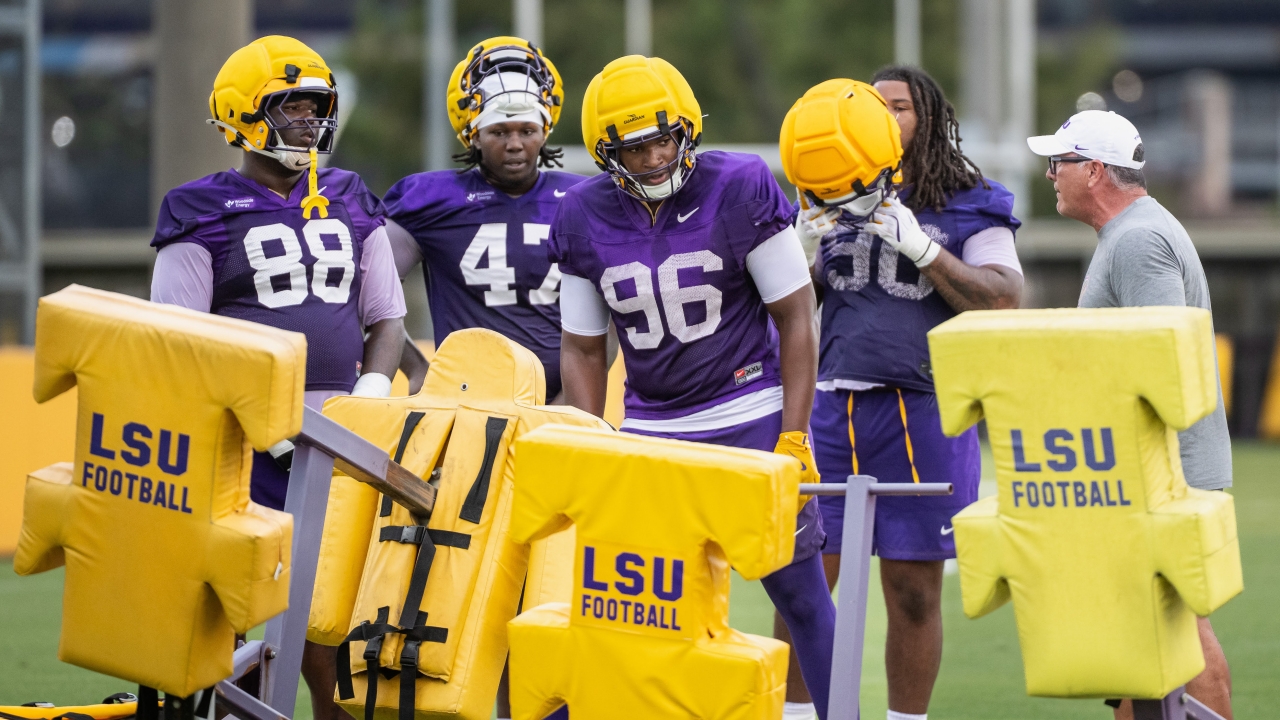
For decades, one of the most common beliefs surrounding LSU football has been simple: If LSU keeps Louisiana's best players home, the Tigers are going to win.
However, LSU is going to employ a very different strategy in 2026, as it has by far the fewest Louisiana players on the roster in decades - possibly ever.
At just, 37.5% of the roster coming from the boot state, it’s actually 11 percentage points lower than the next closest roster.
But does the data actually support that?
I went through every LSU football roster from 2000 through 2026 and calculated what percentage of each roster came from Louisiana. Then I compared those numbers with LSU's record that season.
The result isn't a perfect formula. There are exceptions in both directions, and nobody should pretend that the percentage of Louisiana players on a roster is the sole factor that determines how many football games LSU will win.
But there is a discernible trend.
LSU's greatest teams have generally carried a larger percentage of Louisiana players than some of its worst teams.
And when you isolate seven seasons at the opposite ends of LSU's modern history, the contrast becomes especially difficult to ignore.
Seven Seasons That Jump Off the Page
Start with three of LSU's worst seasons of the past quarter century: 2020, 2021 and 2025.
| Season | Record | Louisiana Players |
|---|---|---|
| 2025 | 7-6 | 50.5% |
| 2021 | 6-7 | 49.6% |
| 2020 | 5-5 | 48.6% |
Those three teams averaged just 49.6% Louisiana players on their rosters.
The only other team in this range was 2023, which did win 10 games and produce one of the better offenses in school history. But on the other side of the ball, It may as well have been a .500 football team.
Now compare them with four of the greatest LSU teams of the modern era.
| Season | Record | Louisiana Players | Result |
|---|---|---|---|
| 2019 | 15-0 | 55.7% | National Champions |
| 2011 | 13-1 | 65.0% | SEC Champions / National Championship Appearance |
| 2007 | 12-2 | 57.6% | National Champions |
| 2003 | 13-1 | 67.2% | National Champions |
Every one of those four teams had at least 55% of its roster from Louisiana.
The average among the four was approximately 61.4%.
That is nearly a 12-percentage-point difference from the three struggling teams highlighted above.
Put in the simplest possible terms:
LSU's worst seasons have tended to feature a lower amount of Louisiana talent, while its very best seasons have featured rosters with at least 55% Louisiana players.
The Complete 26-Year Picture
Cherry-picking only seven seasons would not tell the entire story, so here is the complete dataset.
The table below shows LSU's Louisiana roster percentage and final record for every completed season from 2000 through 2025.
| Season | Louisiana Roster % | Record | Win % |
|---|---|---|---|
| 2026 | 37.5% | ? | ? |
| 2025 | 50.5% | 7-6 | 53.8% |
| 2024 | 56.6% | 9-4 | 69.2% |
| 2023 | 50.4% | 10-3 | 76.9% |
| 2022 | 52.6% | 10-4 | 71.4% |
| 2021 | 49.6% | 6-7 | 46.2% |
| 2020 | 48.6% | 5-5 | 50.0% |
| 2019 | 55.7% | 15-0 | 100.0% |
| 2018 | 55.2% | 10-3 | 76.9% |
| 2017 | 58.8% | 9-4 | 69.2% |
| 2016 | 59.5% | 8-4 | 66.7% |
| 2015 | 62.8% | 9-3 | 75.0% |
| 2014 | 57.6% | 8-5 | 61.5% |
| 2013 | 62.0% | 10-3 | 76.9% |
| 2012 | 68.3% | 10-3 | 76.9% |
| 2011 | 65.0% | 13-1 | 92.9% |
| 2010 | 56.2% | 11-2 | 84.6% |
| 2009 | 58.4% | 9-4 | 69.2% |
| 2008 | 57.9% | 8-5 | 61.5% |
| 2007 | 57.6% | 12-2 | 85.7% |
| 2006 | 67.2% | 11-2 | 84.6% |
| 2005 | 67.8% | 11-2 | 84.6% |
| 2004 | 67.5% | 9-3 | 75.0% |
| 2003 | 67.2% | 13-1 | 92.9% |
| 2002 | 74.2% | 8-5 | 61.5% |
| 2001 | 73.3% | 10-3 | 76.9% |
| 2000 | 75.2% | 8-4 | 66.7% |
What the Full Dataset Actually Tells Us
The complete table is important because it prevents us from overstating the argument.
A high percentage of Louisiana players does not automatically produce a championship.
Look at 2002. Approximately 74.2% of LSU's roster came from Louisiana, yet the Tigers went 8-5.
There are plenty of individual seasons that break the pattern.
Across all 26 completed seasons, the relationship between Louisiana roster percentage and winning percentage is positive, but relatively modest. In other words, teams with more Louisiana players have tended to win more often, but Louisiana representation alone clearly does not explain LSU's success.
That makes sense. Football is far too complicated for one number to explain everything.
Quarterback play matters. Coaching matters. Strength of schedule matters. Player development matters. Injuries matter. The transfer portal now matters considerably more than it did for most of this 26-year sample.
Still, the extremes are fascinating.
LSU's three national championship teams in this dataset all cleared 55% Louisiana representation: 67.2% in 2003, 57.6% in 2007 and 55.7% in 2019.
Personally, I would feel much more comfortable hitting that 55% bar every season. LSU is one of three teams to win three or more national titles in the BCS / Playoff era. That run was fueled by exceptional Louisiana talent that LSU doesn’t have to share with any in-state competition.
The 2011 SEC championship team, which went 13-0 before losing in the BCS National Championship Game, was 65.0% Louisiana.
Meanwhile, two of the only three losing or .500 seasons in the sample came with the two lowest Louisiana percentages of any completed season: 48.6% in 2020 and 49.6% in 2021.
Then came 2025 at 50.5%, when LSU finished just 7-6.
That doesn't prove cause and effect.
But it certainly gives LSU fans a reason to pay attention to where the roster is coming from.
Louisiana Has Been the Foundation, Not the Entire Formula
None of this should be interpreted as an argument that LSU should stop recruiting nationally.
Quite the opposite.
LSU's greatest teams combined elite Louisiana talent with elite players from outside the state.
The 2019 team is perhaps the perfect example.
Joe Burrow came to LSU from Ohio. K'Lavon Chaisson was from Texas. Grant Delpit was also from Texas.
But the Louisiana core of that team was extraordinary.
Ja'Marr Chase was from Harvey. Justin Jefferson was from St. Rose. Clyde Edwards-Helaire was from Baton Rouge. Derek Stingley Jr. was from Baton Rouge. Kristian Fulton was from New Orleans. Patrick Queen was from Ventress. Terrace Marshall Jr. was from Bossier City.
That's the distinction.
The historical LSU formula hasn't necessarily been to build an entire roster from Louisiana.
It has been to build the foundation in Louisiana and supplement it with elite national talent.
When LSU has done both at a high level, the ceiling has been enormous.
And Then There's 2026
This is where the data becomes particularly interesting for the upcoming season.
Based on the current roster snapshot used for this study, LSU has 42 Louisiana players on a 112-player roster.
That's just 37.5%.
If that number holds, it wouldn't merely be lower than LSU's championship teams.
It would be the lowest Louisiana roster percentage in this entire study by a massive margin.
For perspective, the previous low among the 26 completed seasons was 48.6% in 2020.
The gap between 2026's current 37.5% figure and that previous low is more than 11 percentage points.
And that makes this season a fascinating test case.
| Season | LA Players | Roster | LA % | Record |
|---|---|---|---|---|
| 2026 | 42 | 112 | 37.5% | ??? |
The modern transfer portal makes LSU's 2026 roster fundamentally different from teams built 10, 15 or 20 years ago.
Programs can now replace large portions of their rosters almost overnight. A player doesn't have to grow up in Louisiana, sign with LSU out of high school and spend four years in Baton Rouge to become an important Tiger.
That could mean the relationship uncovered in this data is becoming less important in the portal era.
Or 2026 could reinforce it.
If LSU wins at an elite level with only 37.5% of its roster coming from Louisiana, it would be powerful evidence that the construction of college football rosters has changed enough that LSU no longer needs the same percentage of homegrown players it once did.
But is this a band-aid fix for just one season during a coaching change and roster overhaul? Or the new long-term vision?
If LSU struggles again, however, the comparison with the program's championship teams is going to become even harder to ignore.
My take: I’m not saying this team is doomed. I believe this 2026 team will be good. However, I just don’t think having 2/3 of the roster from out of state is a long-term strategy for success at LSU.
After all, it isn’t money or elite coaching that carried LSU to those championships - it was Louisiana talent.